
Why Are Transportation Companies Failing in Brazil?
Beyond the Surface: Uncovering the Real Reasons Behind the High Failure Rate of Carriers in Brazil
Gui Gatti
1/15/20261 min read
The recent decision by FedEx to shut down its domestic express and LTL operations in Brazil is often treated as an isolated case. It isn’t. It is simply the latest and most visible example of a pattern that has been repeating itself for years across the country’s transportation sector.
According to industry estimates from Tigerlog and NTC&Logística, thousands of road-freight operators have exited the market in the past decade, including well-known LTL and FTL players.
What is wrong?
Publicly reported restructuring filings, court records and industry analyses (Valor Econômico, Exame, Transporte Moderno, NTC&Logística) point to a consistent set of drivers:
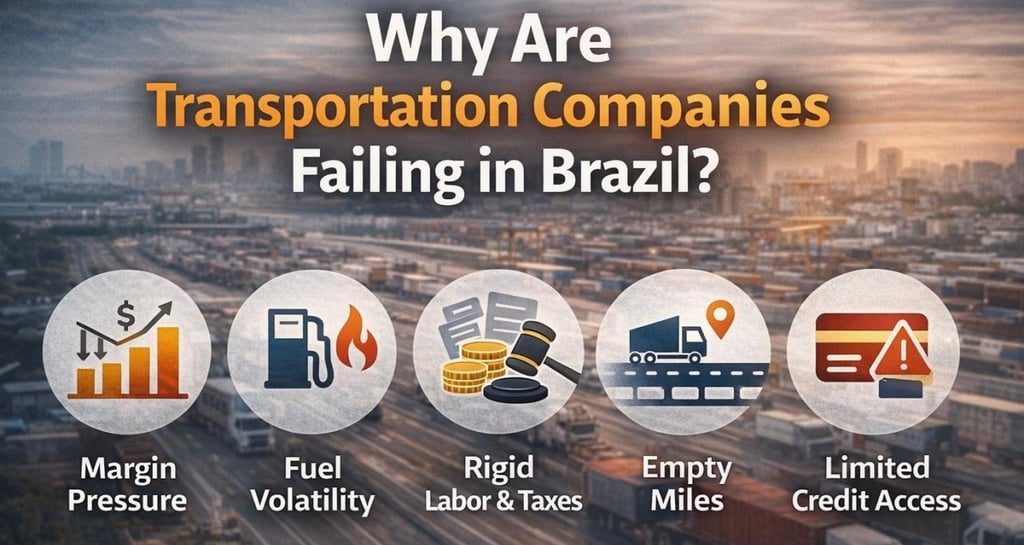
• Chronic margin pressure in LTL and contracted FTL, with limited ability to reprice
• Fuel volatility, amplified after the 2018 truckers’ strike
• Rigid labor and tax structures, especially for asset-heavy operators
• Low network density outside major corridors, driving empty miles
• High working-capital requirements and restricted access to credit
Why Brazil is uniquely complex?
Reliable studies from IBGE, World Bank Logistics Performance Index, and OECD transport outlooks consistently highlight Brazil’s challenges:
• One of the highest tax complexities in the world
• Heavy dependence on road freight (over 60% of cargo)
• Fragmented ownership, dominated by owner-operators
• Regulatory uncertainty and slow infrastructure execution
In this environment, scale alone becomes a liability rather than a competitive advantage.
Looking ahead: who is winning — and why?
Despite these failures, success stories do exist. Digital freight platforms, asset-light operators, ecosystem players and specialized regional carriers are growing.
The difference is clear:
• Clear focus on creating value to customers, and turning it into margins
• Truly flexible cost structure
• Technology-driven network orchestration
• Strong density on selected lanes
• Relentless focus on cash flow and execution
The future of transportation in Brazil will favor adaptability and the technology creating value-proposition and driving margins, over simply scale and network size. Those these will be on a much favorable position to win. And those that continue to rely on legacy, asset-heavy models and pushing volume without margin, are likely to face the same outcome seen with FedEx and many others before it.