
Stop managing parcel networks like a factory: why “cost-per-package” is a margin trap
Strategic Failures and Structural Hurdles: The Reality of Transportation Companies in Brazil.
Gui Gatti
2/4/20264 min read
This article is not grounded in academic research or theoretical models. It is shaped by more than 33 years of empirical, on-the-ground experience in global transportation and logistics, leading operations, managing P&Ls, negotiating complex commercial agreements, and witnessing firsthand which business models create sustainable value and which ultimately fail to close operations.
Across different markets, cycles, and disruption waves, I have seen strategies celebrated as “efficient” in the short term quietly erode resilience, customer trust, and long-term performance. The reflections that follow emerge from those real-world lessons, informed by what consistently works, and what repeatedly does not.
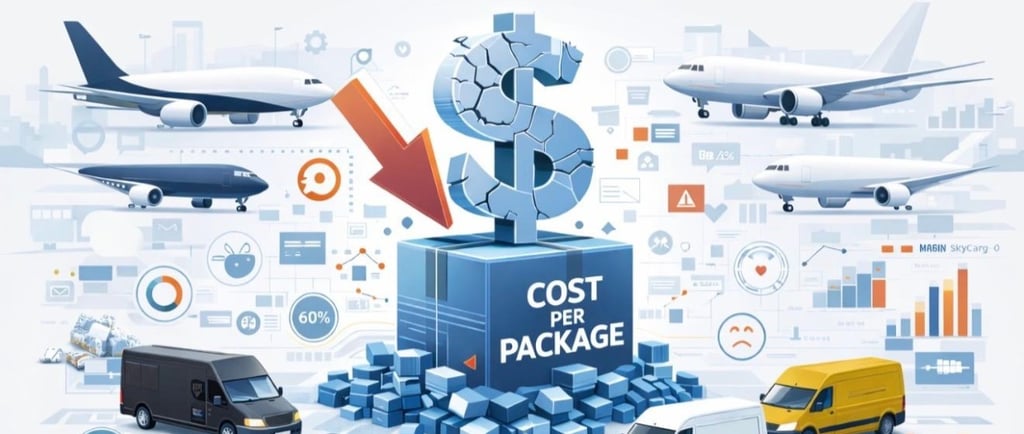
In transportation, cost-per-package (or cost-per-piece) is one of those metrics that feels “clean,” objective, and operationally responsible. But as a strategy to protect margins, it’s become a trap.
Because when leadership optimizes the organization around driving cost-per-package down, the business usually drifts into three bad habits:
1. It commoditizes the product (everything becomes “just a box”).
2. It rewards service trade-offs (quality becomes an expense, not a revenue lever).
3. It hides the real margin story: yield, mix, and cost-to-serve.
Meanwhile, the express parcel industry is in a very different reality than it was a decade ago: flatter growth, volatile demand, shorter contracts, higher uncertainty (tariffs, trade policy swings, inventory resets), and relentless customer expectations shaped by digital-first experiences.
So if you want stronger margins, the question is no longer “How do we cut cost per package?" It's: “How do we earn better quality revenue per package, consistently and overtime, by delivering a value proposition customers will pay higher yields for?”
An obsessive focus on “cost-per-package” risks becoming strategically myopic in an environment defined by heightened uncertainty and rapid technological acceleration. What is frequently framed as operational optimization, can in practice, obscure broader structural risks and constrain long-term value creation.
1) It pushes you to cut the wrong costs. In express, many costs are not just “costs.” They’re capabilities:
delivery density strategy (where you choose to compete)
service recovery (preventing churn)
proactive exception management
network resiliency (extra lift, contingency capacity)
When you squeeze cost-per-package too hard, you often reduce the very things that protect yield.
2) It ignores that not all packages are created equal. A lightweight residential delivery with a predictable route is not the same “unit” as a time-definite healthcare shipment, a high-value cross-border parcel or a shipper that creates constant exceptions and billing disputes.
Cost-per-package averages away the truth: margin is driven by mix + shipping behavior + operational adherence to demand.
3) It quietly increases indirect variable cost. While most leaders focus on direct variable cost such as pickup & delivery labor, linehaul/airline lift and sort handling, the "silent killer" is indirect variable cost. And they rise with complexity:
claims, losses & damage handling
customer contacts (“where is my package?” calls/chats/messages)
address correction and delivery re-attempts
invoice disputes and credits
exception management, rework inside hubs and at last-mile operations
returns complexity and reverse logistics friction
Ironically, a cost-per-package culture often increases these indirect costs by degrading quality, accuracy, and communication. A snowball that can shut-down business.
The alternative: a “Value Proposition Model” that expands yield and protects margins. Here’s what I mean by a value-proposition model:
1) Define what customers actually pay for (and what they don’t).
Not “fast shipping” necessarily, but there are other key components of value, such as reliability (on-time and predictable variability), visibility (proactive, high-quality tracking and exception alerts), control (delivery options, intercepts, signatures, reroutes), simplicity (clean billing, fewer disputes, fewer surprises), trust (damage performance, claims experience, accountability) and specialization (healthcare, high-value, cross-border compliance).
Then make those elements visible, measurable, and priceable.
2) Price to value, not to averages
If pricing is shifting toward more continuous recalibration and segmentation, carriers should use that shift to reward: good shipper behavior (label quality, pickup readiness, low exception rates), dense lanes and predictable volume profiles and premium service needs with clear willingness to pay .
This is where technology and AI become margin multipliers, not only by cutting cost, but by enabling smarter yield management.
3) Use automation/AI to attack both direct and indirect variable costs
Automation and AI shouldn’t be framed only as “labor replacement.” The bigger opportunity is friction removal. For instance:
Better ETA accuracy, which turns into fewer contacts and escalations
Better exception prediction that drive fewer failed deliveries and rework
Better dimensional capture and data integrity, generating fewer billing disputes and credits
Better network planning, creating ewer touches per shipment and less variability
Done right, CX improvements reduce indirect variable cost and increase willingness-to-pay.
So, what to measure instead of “cost-per-package”?
If you want margins, shift the leadership dashboard from a single efficiency KPI to a value + yield + cost-to-serve system, for example:
Value / Experience
On-time performance by customer segment
Claims rate + time to resolution
Exception rate (and preventable exceptions)
First-attempt delivery success
Digital self-service adoption
Customer effort score / NPS (where applicable)
Yield
Revenue per package, "net of credits"
Price realization vs. list (by segment)
Mix improvement (premium, specialized, cross-border)
Cost-to-serve
Direct variable cost by lane/segment
Indirect variable cost per shipment (contacts, disputes, rework)
Touches per shipment and “avoidable touches”
This turns margin improvement into a systems problem, not a quarterly cost-cutting contest.
Finally, in volatile markets, you can’t spreadsheet your way to sustainable margins. Logistics executives need a clear strategic choice:
A) If you compete as a commodity, you will be managed like a commodity.
B) If you compete on a differentiated value proposition, you can price like it.
Cost-per-package will always matter operationally. But as a strategy, it will keep pulling you toward the lowest-common-denominator service, precisely when customers are demanding more reliability, more visibility, better management of exceptions and more control.
Sustainable margins don’t come from cheaper packages. They come from better value, better yields, and satisfied, loyal customers.